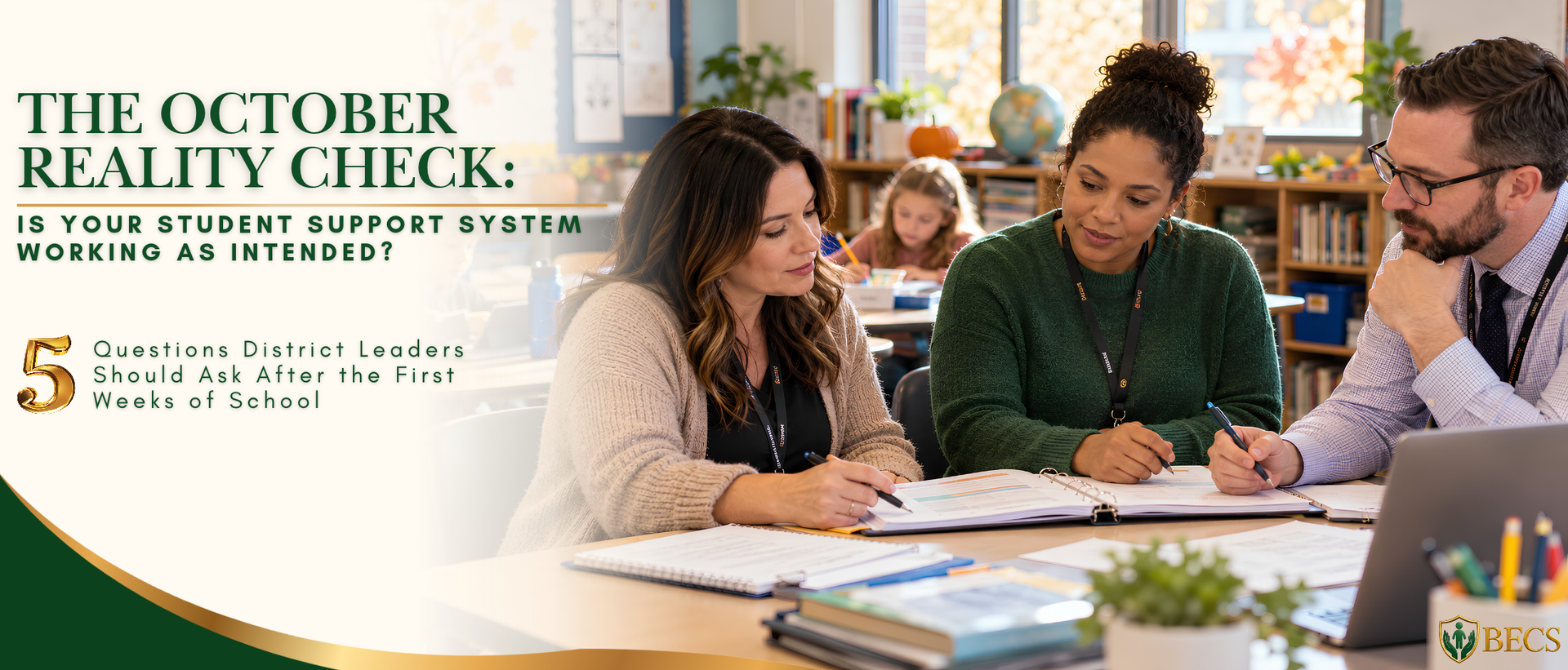
The October Reality Check: Is Your Student Support System Working as Intended?
When the School Year Moves From Planning to Practice
By October, the excitement and anticipation of a new school year have begun to settle into everyday routines. Classrooms are finding their rhythm, students are adjusting to expectations, and educational teams are navigating the realities of delivering services and support.
For district and special education leaders, this period presents an important opportunity.
The staffing plans, professional development sessions, student support strategies, and operational decisions made before the school year are now being tested in real environments.
And while a program may appear fully staffed and operational on paper, that doesn't necessarily mean every component is functioning as intended.
The question is no longer simply, "Are we ready for the school year?"
It's now, "Are the systems we've put in place actually working for our students and staff?"
October offers an opportunity to move beyond preparation and begin examining implementation, consistency, and effectiveness.
Here are five questions worth asking as the school year progresses.
1. Prepare the Team, Not Just the Schedule
Developing an effective Individualized Education Program (IEP), Behavior Intervention Plan (BIP), or instructional support strategy is an important part of serving students with diverse needs.
But even the most thoughtfully developed plan is only as effective as its implementation.
Consider what happens across a student's day.
Does the student receive consistent support between classrooms, activities, and staff members? Do the individuals responsible for implementing a plan understand its goals and procedures? Are team members communicating when something is working—or when adjustments may be necessary?
Implementation challenges don't always stem from a lack of effort or commitment.
Sometimes, staff haven't received sufficient opportunities to practice strategies. Sometimes, responsibilities aren't clearly defined. In other situations, competing demands make consistent implementation difficult.
What district leaders can do:
- Review whether staff responsible for implementing student support plans have the training, guidance, and resources they need.
- Identify inconsistencies in implementation across environments or personnel.
- Establish opportunities for staff to ask questions, share observations, and receive feedback.
- Ensure student support practices remain aligned with each student's individualized needs and documented services.
The objective isn't to evaluate whether individuals are trying hard enough. It's to determine whether the system enables them to implement supports effectively.
2. Do Staff Understand Their Roles and Have the Support to Fulfill Them?
A fully staffed classroom isn't necessarily a fully supported classroom.
Paraeducators, behavioral support personnel, special education teachers, related service providers, and administrators each contribute to student success.
Yet the effectiveness of these roles depends heavily on clear expectations, communication, and collaboration.
When responsibilities are unclear, challenges can emerge.
A paraeducator may be uncertain about when to provide assistance versus encourage independence. A teacher may assume a support strategy has been communicated when it hasn't. A behavior support professional may lack access to timely feedback or supervision.
Over time, these gaps can create frustration, inconsistent practices, and missed opportunities for student growth.
What district leaders can do:
- Revisit role expectations and responsibilities with educational teams.
- Ensure paraeducators and support staff have access to appropriate instructional direction and supervision.
- Create dependable communication channels between teachers, specialists, and support personnel.
- Ask frontline staff what barriers they encounter when carrying out their responsibilities.
Supporting staff means more than ensuring they are present. It means providing the clarity, direction, and resources necessary for them to contribute effectively.
3. Is Professional Development Translating Into Everyday Practice?
Professional development is an important investment in educational quality.
However, participating in a training session doesn't automatically mean staff are prepared to apply new knowledge confidently in a complex classroom environment.
Consider a team that receives training in proactive behavioral strategies.
The concepts may be clearly explained during the training. Staff may understand the purpose of the strategies and demonstrate familiarity with the terminology.
But what happens when a student becomes overwhelmed during an unexpected transition? What happens when a strategy needs to be adapted to an unfamiliar environment?
Without opportunities for modeling, practice, coaching, and feedback, the distance between knowing a strategy and implementing it effectively can remain significant.
What district leaders can do:
- Identify which training topics staff are actively applying in their daily work.
- Provide opportunities for job-embedded coaching and guided practice.
- Encourage teams to discuss implementation challenges and successful strategies.
- Gather feedback about which areas require additional support or clarification.
Effective professional development shouldn't end when a training session concludes. It should contribute to ongoing growth in staff confidence, consistency, and practical skill development.
4. What Is the Data Telling Us—and Are We Listening?
By October, educational teams have begun collecting valuable information about how students and programs are functioning.
This information can offer insight into patterns that may not have been visible during the planning stages.
Student progress monitoring, behavioral data, staff feedback, service delivery documentation, attendance patterns, and operational observations can all contribute to a more complete understanding of program effectiveness.
For example, a classroom may be experiencing an increase in behavioral incidents during certain transitions.
Without examining the circumstances, a team might conclude that additional staffing is necessary.
However, a closer review may reveal that expectations are inconsistent, environmental demands have changed, or existing support strategies need refinement.
Additional personnel may sometimes be appropriate, but staffing decisions are stronger when informed by a careful examination of student needs and existing practices.
What district leaders can do:
- Review student and program data for emerging patterns.
- Examine whether current interventions and supports are producing the intended results.
- Include frontline staff perspectives when interpreting information.
- Identify opportunities for targeted adjustments before considering larger operational changes.
Data should be more than a compliance requirement or a collection of numbers. When reviewed thoughtfully, it becomes a tool for informed decision-making and continuous improvement.
5. Are Our Support Systems Building Student Independence?
One of the most important questions in special education is also one that can be easy to overlook during demanding school days:
Are the supports we're providing helping students develop greater independence, participation, and confidence?
Adult assistance plays a critical role in helping many students access learning, navigate their environments, and develop new skills.
However, effective support is not always measured by how much assistance an adult provides.
Sometimes, meaningful progress looks like a student completing part of a task with fewer prompts, independently initiating communication, navigating a familiar routine, or participating more fully alongside peers.
These outcomes require intentional planning, individualized strategies, and appropriate monitoring.
The goal is not to remove necessary support or prioritize independence at the expense of student safety, access, or individualized needs.
Rather, it's to ensure that assistance is purposeful and, when appropriate, designed to help students develop skills and increasing autonomy over time.
What district leaders can do:
- Encourage teams to review whether adult support promotes meaningful student participation.
- Examine opportunities for individualized prompt fading and skill development when appropriate.
- Ensure decisions about support levels remain guided by student needs, IEP requirements, and team collaboration.
- Recognize progress in independence, communication, and participation alongside academic outcomes.
Strong student support systems do more than help students get through the school day. They create opportunities for students to develop skills that extend beyond the classroom.
From Early Observations to Meaningful Improvements
October doesn't need to be a month of major program overhauls.
In many cases, the most meaningful improvements begin with smaller, intentional adjustments.
A clearer communication process.
Additional coaching for a staff member.
A more consistent approach to implementing a student support plan.
A closer examination of behavioral data.
A renewed focus on student independence.
Individually, these actions may seem modest. Collectively, they can strengthen the consistency and effectiveness of an entire support system.
For district leaders, the opportunity lies in establishing a culture where reviewing implementation is a normal part of educational leadership—not something reserved for moments of crisis.
When teams regularly examine what is working, identify emerging needs, and respond thoughtfully, they are better positioned to support both students and the professionals serving them.
Building Stronger Systems, One Adjustment at a Time
At Burgio Educational Consulting Services (BECS), we believe sustainable student support begins with understanding what is happening in practice.
Effective programs require more than staffing plans, documented procedures, or professional development schedules.
They require alignment between student needs, staff preparation, implementation practices, and ongoing leadership support.
As the school year progresses, October offers a valuable opportunity to reflect on those connections.
Not every challenge requires an entirely new system. Sometimes, the most effective next step is identifying where an existing system needs greater clarity, consistency, or support.
The strongest programs aren't necessarily those that begin the year without challenges. They're the ones equipped to recognize challenges, learn from them, and respond with intention.
Ready to Take a Closer Look at Your Student Support Systems?
Whether your district is evaluating staffing effectiveness, strengthening classroom practices, or identifying opportunities for professional growth, BECS can help you examine existing structures and explore practical next steps.
Our work focuses on helping educational teams build the capacity, confidence, and consistency needed to support meaningful student outcomes.
Explore BECS district support services or connect with our team to start a conversation about your program's needs.