When Student Support Programs Start Running on Heroics
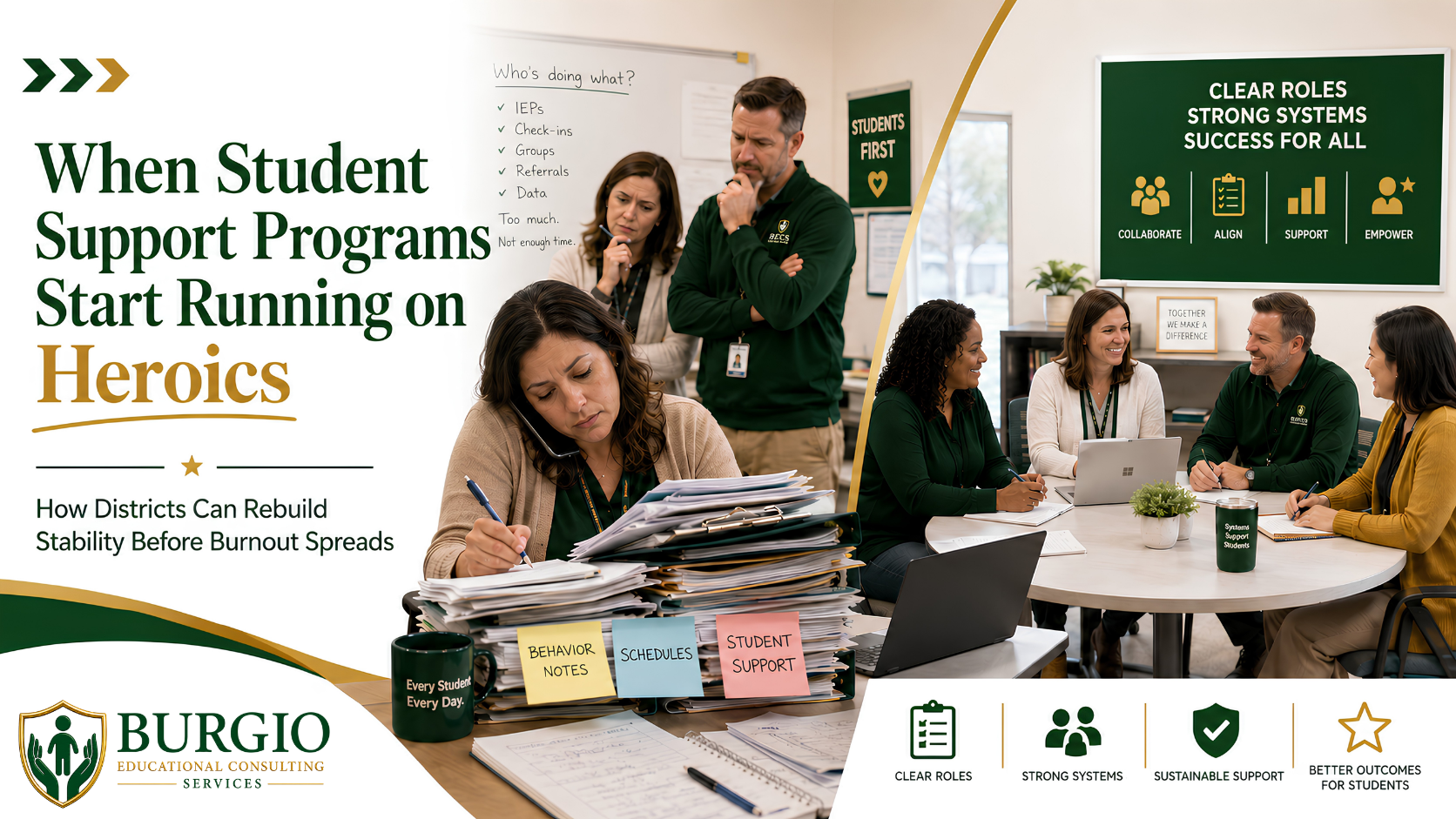
How Districts Can Rebuild Stability Before Burnout Spreads
Every district has people who step up when things get hard.
The paraeducator who always knows how to calm a student.
The teacher who stays late to rewrite plans.
The program lead who quietly fills every gap.
The administrator who spends the day problem-solving emergencies instead of leading the work they planned to do.
These people are often the reason a program continues to function.
But when a student support system depends on a few heroic individuals to hold everything together, it is not truly stable. It is vulnerable.
Heroics can get a team through a difficult week. They cannot sustain an entire school year.
The reality district leaders are facing
Student needs are increasing. Staff are stretched. Behavior concerns are more complex. Inclusion expectations remain high. Families need communication and confidence. Teams need clarity, support, and follow-through.
In many districts, programs are not failing because people do not care. They are struggling because the system around the people is not strong enough to hold the level of need.
That may look like:
- One staff member carrying most of the behavior support knowledge
- Inconsistent implementation of behavior plans or student support plans
- Paraeducators unsure of their role or expectations
- Teachers feeling isolated with high-need students
- Administrators responding to repeated incidents without time to address root causes
- Student support programs relying heavily on temporary fixes
- Staff burnout spreading across a classroom, program, or building
When this happens, districts often feel pressure to move quickly. The first instinct may be to add coverage, shift staff, or find another person to help.
Sometimes additional staffing is necessary. But often, the bigger question is: What system needs to be strengthened so the team is not dependent on one person to make everything work?
Why hero-based systems break down
Hero-based systems are fragile because they rely on individual effort instead of shared structure.
If the “go-to” staff member is absent, the team struggles.
If the program lead leaves, institutional knowledge walks out the door.
If a student escalates, everyone looks for the one adult who knows what to do.
If a new staff member joins the team, they may not receive enough training or coaching to implement supports consistently.
This creates stress for everyone.
Students experience inconsistency. Staff feel unsure. Families may lose confidence. Leaders spend more time reacting to urgent problems instead of strengthening the program.
The goal is not to remove strong people from the equation. Strong staff are an asset. The goal is to stop making them the entire system.
What program stability actually requires
A stable student support program is not perfect. It still has hard days. Students still have needs. Staff still need support.
But stable programs have a structure that helps people respond consistently.
They usually include:
- Clear roles and responsibilities
- Shared understanding of student support plans
- Practical staff training
- Coaching and follow-up
- Consistent routines and expectations
- Behavior support strategies that are understood by the team
- Communication systems that prevent confusion
- Leadership support that is proactive, not only reactive
- A plan for sustainability when staff change or student needs increase
When these pieces are in place, teams are less dependent on one person. Support becomes more consistent, and staff have a clearer path forward.
Where BECS fits into the solution
BECS partners with districts to help identify what is creating pressure and what support path makes the most sense.
For some districts, the need is Program Stabilization. This may include observation, needs review, staffing pattern review, role clarity, paraeducator coaching, classroom systems support, behavior-support guidance, and practical next-step planning.
For others, the right starting point may be Professional Development, especially when staff need training in behavior support, inclusion strategies, de-escalation, data collection, or implementation of student plans.
Some districts may need Consultation and Inclusion Support to help teams strengthen inclusive practices, student-centered planning, IEP implementation, or systems-level support.
Others may benefit from Workforce Optimization to look at role alignment, staff deployment, retention, onboarding, training systems, and long-term capacity.
And when additional adult support is needed, BECS can also provide Staffing Support designed to complement, not replace, district capacity-building efforts.
The key is that the solution should match the problem.
A better question for district teams
Instead of asking only, “Who can we add?” districts can ask:
- What is currently working?
- Where is the system breaking down?
- Which roles are unclear?
- What support plans are not being implemented consistently?
- What training or coaching does the team need?
- Are we building student independence or creating more adult dependency?
- What happens if the strongest staff member is absent?
- What would make this program more sustainable three months from now?
These questions move the conversation from crisis response to capacity-building.
The takeaway
District teams should not have to survive on heroics.
Strong people matter. But strong systems protect students, staff, and programs over time.
When district leaders invest in program stability, they help staff feel more confident, students experience more consistency, and administrators gain a clearer path forward. BECS helps districts move from “barely holding it together” to building support systems that are practical, inclusive, and sustainable.
Is your district relying on a few key people to hold student support systems together? BECS can help identify the right next step through Program Stabilization, Professional Development, Consultation, Workforce Optimization, or Staffing Support.
Explore Workforce Optimization →