
Summer Structure Without the Stress: 5 Simple Routines That Help Kids Feel Calm and Successful
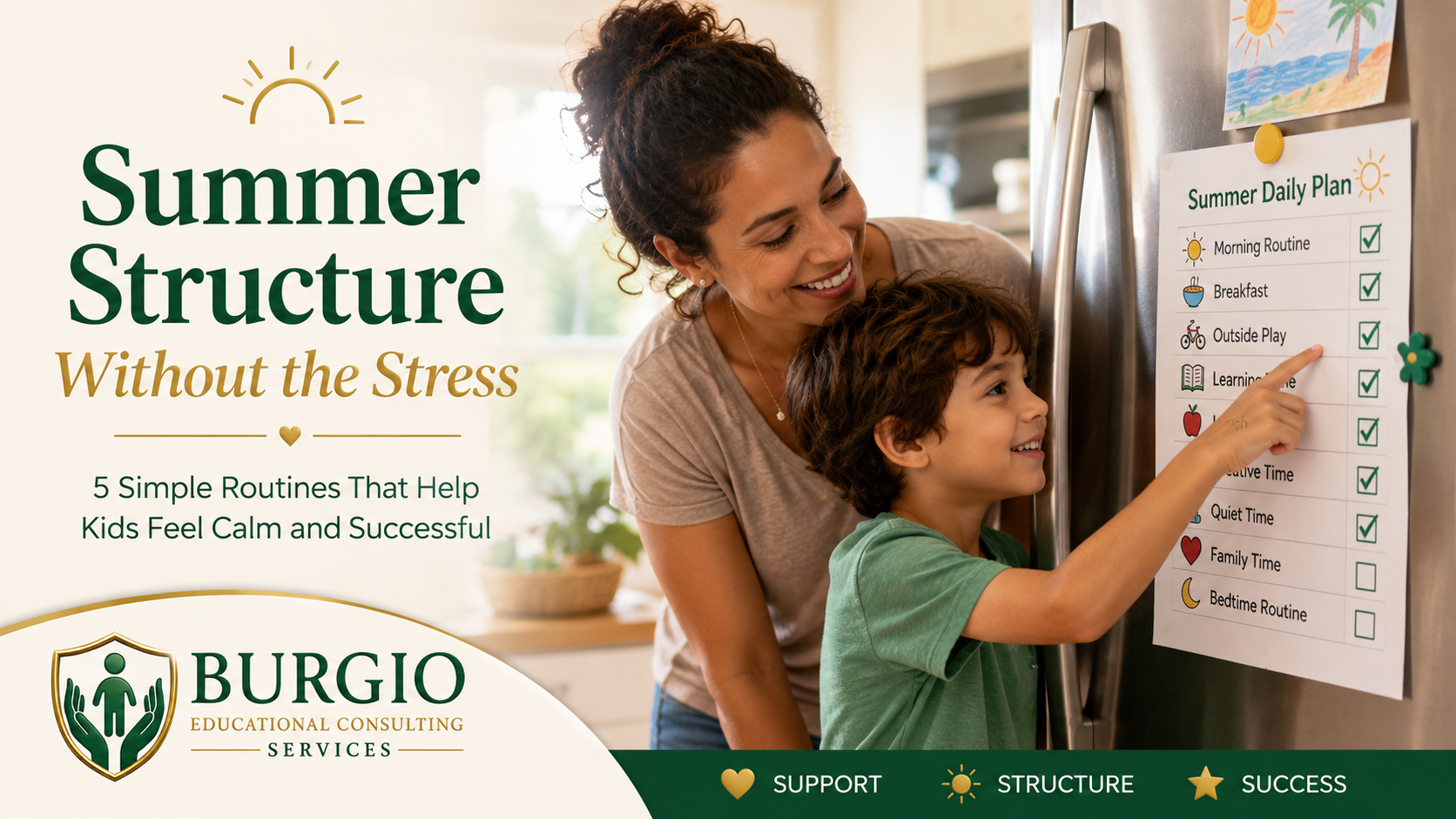
Summer can be a wonderful season for families. It can also be a lot.
Longer days, later bedtimes, changing routines, vacations, visitors, heat, camps, childcare changes, and more time at home can make summer feel less like a break and more like a daily juggling act.
For children who do best with predictability, including children with complex support needs, the shift from school-year structure to summer flexibility can be hard. You may notice more big feelings, more resistance, more meltdowns, more questions, or more difficulty moving from one activity to the next.
That does not mean you are doing anything wrong.
It usually means your child is trying to make sense of a day that feels less predictable than usual. And honestly, many adults feel that way during summer too.
The good news is that you do not need a color-coded schedule, a perfect routine, or a Pinterest-worthy plan to help your child feel more settled. A few simple routines can make the day easier for everyone.
Here are five practical ways to bring more calm and structure into summer without adding more pressure to your plate.
1. Give the Day a Simple Shape
Children often feel more secure when they know what is coming next. This does not mean every minute needs to be planned. It just means giving the day a basic rhythm.
Try writing or drawing a short plan for the day:
- Morning
- Outside time
- Lunch
- Quiet time
- Errands
- Screen time
- Dinner
- Bedtime
- That is enough.
You can use a whiteboard, sticky notes, a piece of paper on the fridge, pictures, or a simple checklist. For some children, seeing the plan helps reduce repeated questions. For others, it helps prepare their body and brain for what is coming.
A simple phrase can help:
“Here’s what today looks like.”
If the plan changes, that is okay. You can update it together and say:
“We had a change. Let’s look at the new plan.”
This teaches flexibility while still offering reassurance.
2. Use “First, Then” Language
When children are overwhelmed, too many words can make things harder. “First, then” language keeps directions simple and clear.
Try:
“First shoes, then park.”
“First bathroom, then snack.”
“First clean up, then tablet.”
“First quiet time, then outside.”
This works because it tells your child two important things: what needs to happen now and what is coming next.
It can also reduce negotiation because the expectation is clear. You are not giving a long lecture or trying to convince your child. You are calmly showing the next step.
If your child needs visual support, you can even write or draw the two steps.
FIRST: Clean up
THEN: Water play
Simple is often better.
3. Give warnings before transitions
Transitions can be one of the hardest parts of the day. Leaving the park, turning off a screen, getting out of the pool, stopping a favorite activity, or moving from playtime to errands can bring big feelings quickly.
That does not mean your child is being difficult. Transitions are a skill, and many children need support to practice them.
Try giving a few gentle warnings:
“Ten more minutes, then we are leaving.”
“Five more minutes, then shoes.”
“One more turn, then all done.”
“When the timer rings, it is time to clean up.”
Timers can be helpful because they make the transition feel less personal. Instead of the adult being “the bad guy,” the timer becomes the cue.
Some families also like using a transition object. For example, your child can carry a favorite small toy from the car to the store, or hold the snack bag while walking from the park to the car.
The goal is not to avoid every hard moment. The goal is to make the next step easier to understand.
4. Build in One Calm Reset Each Day
Summer can be overstimulating. Heat, noise, crowds, travel, siblings, screen time, and busy schedules can all add up.
A daily reset gives your child a chance to slow down before things boil over. This does not have to be a nap, and it does not have to be long.
A reset could be:
Reading books
Listening to quiet music
Lying under a blanket
Playing with sensory toys
Drawing
Sitting in a quiet room
Having a snack and water
Doing a puzzle
Taking a short break from talking
You can call it “quiet time,” “body break,” “reset time,” or whatever fits your family.
This is not a punishment. It is not a consequence. It is a chance for everyone’s nervous system to take a breath.
You might say:
“We’ve had a busy morning. Let’s give our bodies a reset.”
Parents and caregivers can take this reset too. Sometimes the most helpful routine is one that gives everyone a few minutes to breathe..
5. Choose One Routine to Protect
You do not need the whole day to be predictable. Pick one routine that stays mostly the same, even when the rest of the day is flexible.
For many families, bedtime is the best place to start. For others, it may be lunch, morning routine, quiet time, or the after-dinner routine.
A bedtime routine might look like:
Bath or shower
Pajamas
Brush teeth
Book
Talk about tomorrow
Lights out
A morning routine might look like:
Bathroom
Get dressed
Breakfast
Check the day’s plan
When one part of the day feels steady, children often handle the flexible parts better.
And when the routine falls apart? That is okay. You can start again the next day.
Progress counts, even when it is messy.
A Quick Reminder for Hard Moments
When behavior gets big, it can help to pause and ask:
What might my child be trying to tell me?
Maybe they are tired.
Maybe they are hungry.
Maybe the room is too loud.
Maybe they do not understand the plan.
Maybe they need help stopping an activity.
Maybe they are disappointed and do not yet have the words to say it calmly.
Behavior is often communication. When we look underneath the behavior, we are more likely to find the need.
That does not mean there are no boundaries. Children still need limits. But limits can be calm, clear, and supportive.
Try:
“I know you wanted more time. It is still time to go.”
“You are upset. I am here. First shoes, then car.”
“We can try again after a break.”
“It is okay to be mad. It is not okay to hit.”
Calm does not mean permissive. Calm means steady.
Start Small
If summer feels chaotic right now, choose just one idea from this list.
You might start with a simple daily plan.
You might use a timer for transitions.
You might protect bedtime.
You might add one quiet reset after lunch.
You do not have to do all five.
Families are already carrying a lot, and small changes can make a meaningful difference. A little more predictability can help children feel safer, calmer, and more successful — and it can help parents and caregivers feel less like they are starting from scratch every day.
At BECS, we believe support should feel practical, respectful, and doable. Families do not need perfection. They need tools that work in real life.
This summer, start small. Keep it simple. Celebrate what works. And remember: structure is not about controlling the day. It is about helping everyone move through the day with a little more confidence and calm.